Posts for category Digital Rights


July 13th, 2010  |  Filed under Digital Rights

Beyond Camera Consumerism, Photography Can Also Be Art

[Olivier Bonin, filmmaker, responds to a prompt from excerpts from Susan Sontag's seminal essay, On Photography (1977) and from the Burning Man website, to reflect on documentation on the playa. This post is part of the Digital Rights Blog Series.]

Susan Sontag

Background

Susan Sontag, American author, artist and literary theorist, lived from January 16, 1933 – December 28, 2004, but her work lives on in art schools around the world. In 1977, Sontag wrote the essay On Photography, which continues to provide media students and scholars an entirely different perspective of the camera in the modern world.

Our Prompt

We sent Olivier the following prompt to respond to:

“Review these excerpts from On Photography by Susan Sontag (1977):

1. To collect photographs is to collect the world.

2. Photographs furnish evidence.

3. That age when taking photographs required a cumbersome and expensive contraption — the toy of the clever, the wealthy, and the obsessed — seems remote indeed from the era of sleek pocket cameras that invite anyone to take pictures.

Review this excerpt from Burning Man’s Ten Principles:
‘Our community seeks to create social environments that are unmediated by commercial sponsorships, transactions, or advertising. We stand ready to protect our culture from such exploitation. We resist the substitution of consumption for participatory experience.’ Burning Man Website (2010)”

Olivier’s Response:

Yes, there might be a problem on how we try to document every single thing we see, but that problem is sourced in the way we consume, in the way we are as a society: it is entrenched into our contemporary culture. To change the way we photograph, is to change the way we live almost. It’s all inter-connected… a giant neurosis, that we need to work on all together. And of course I think Burning Man is part of the solution if it demonstrates a bigger interest in the method of doing art together…

On Consumerism
Burning Man prides itself not to participate in consumerism, but to go to Burning Man is to consume. Each person that goes to Burning Man has to spend a lot to be self-reliant for one week in the desert. To create a city in the desert, is to transport everything to this environment. To truly reflect on our consumerist society would require minimizing our exposure to it, but that’s not what a deserted dry lakebed calls for.

Budget Truck in line for Burning Man, ©2007 Dust & Illusions

Budget Truck in Line for Burning Man, ©2007 Dust & Illusions

I would even go further, and say that escaping consumerism was never was part of the original intentions. The need to escape the traps of our larger society was definitely there, but I believe the original intentions of the Burning Man project were to create a temporary site to simply relieve us from the constant attack on our senses of the mainstream cultural Act. It was a place to create our own reality, and express ourselves freely in the rawest manner possible without the need for it to be judged worthy of any value by our society’s standards. It was only later than Burning Man started to be associated with an anti-consumerist alternative, but the resistance to consumption has ever only been expressed through the lack of commercial sponsorship, transaction or advertising, and not necessarily through deeply dealing with the consumption that occurs pre-event.

In the depth of the event, you can of course find a real call from its participants to recreate a world where community is more important than capitalism. There are many examples in the artists’ group, and the theme camps, but these examples need to become the driving principles behind the event in order to effectively alter the consumerist reality. Where Burning Man really thrives is in offering an open stage for anyone’s artistic expression. And that is the single reason why Burning Man is still an important event today. The event has produced important artistic content, and truly inspires people to create! Let’s focus on this aspect to create a community with strong and deep artistic values, and the rest will follow.

Read more »

July 13th, 2010  |  Filed under Digital Rights

Photography Without Consent: A View From Inside The Ride

[Carolyn Ellis, aka Kali, rode in the Critical Tits Ride for several years before becoming one of the principle organizers of this storied Burning Man tradition. This post is part of the Digital Rights Blog Series.]

I care deeply about camera and privacy issues on the playa.  This has not always been the case.  My first Critical Tits Ride changed all of that – no woman who enters that ride with any degree of vulnerability comes out the other end unaware of the cameras and their misuse.  To ride is to experience, and witness first hand, the cost of photography without consent.

Critical Tits Ride, 2005 (Photo by Cameragirl)

Critical Tits Ride, 2005 (Photo by Cameragirl)

To understand the harm inflicted, you must step inside the body of a woman riding topless and attempt to feel how vulnerable and courageous an act that truly is, even at Burning Man.  My greatest wish, for all who ride, is that they would be witnessed with nothing less than compassion and respect.  As a rider and now member of the CT Crew, I would like to offer a perspective from the “composition material” – those who inhabit the images taken, the riders themselves. Join me, if you would, for a perspective from inside the ride. . . .

It feels fabulous, and I mean fabulous, as a woman to ride topless on my bike!!!  No man can ever understand the freedom of a topless bike ride in a female body.  I was slipping free of the ‘rules’ of my family, culture and government – so well programmed that I thought they were my own.  A collective oppressive cloak was sliding off of my body and being powdered into playa dust by all those goddesses on bikes.  It felt so good and free.  An adventure like this would land me in jail in the default world!!  Here at BRC, it was a lyrical day on a bike.

Read more »

July 13th, 2010  |  Filed under Digital Rights

Photography is My Gift to the Community

[Neil Girling, aka mr. Nightshade, is a photographer and blogger well-known for covering the San Francisco Bay Area underground. This post is part of the Digital Rights Blog Series.]

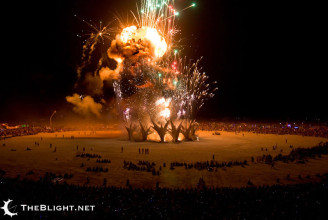
The Man Burns, 2009

The Man Burns, 2009

Six weeks hence will again see me covered in dust, in the middle of a desert wasteland and my largest project of the year, that thing we call Burning Man. It will be the sixth year I bring out a glittering array of sparkling glass and battered camera bodies, trying to somehow make the unimaginable scale of the event fit within a small viewfinder, compressing the four dimensions of time and space (leaving out sound entirely) into a measly two, and somehow still try to convey just what it is like — near sensory overload — within a few photographs.

In 2008, I posted a few photos during the week from the tenuous WIFI connection to my website; last year, I took this up a notch and posted photos each night of the event from their respective day. With a generator running, a laptop atop the pickup and photos of the Man burning trickling up to the web at 3AM — scant hours after his immolation, and while his embers smoldered still — I hastily packed my remaining belongings to escape the mad rush of Exodus, and my photos beat me to the rest of world.

Read more »

July 12th, 2010  |  Filed under Digital Rights

Welcome to Digital Rights: Debates in the Dust

[Rosalie Fay Barnes is a consultant for the Burning Man Project, facilitating the review of current media documentation and legal policies. She also consults with Black Rock Solar, helping to develop k-12 educational materials around climate change, environmental law, and disaster responses. Rosalie earned a double Masters from the Harvard Graduate School of Education focusing on technology and cognitive development, where she worked extensively with Harvard Law School's Berkman Center for Internet & Society, a digital rights think tank. To contact her and/or to inquire about blogging for the Digital Rights Series, email cameratales [Email address: cameratales #AT# burningman.com - replace #AT# with @ ].]

The Media Takes Aim at Larry Harvey, 1998

The Media Takes Aim at Larry Harvey, 1998

As you may have read in the blogosphere, the Burning Man Project has been undergoing a review of legal terms related to media documentation at the event (for media references, see the link list below). And while the goal of this effort is to determine the specific legal language on the ticket and Burning Man’s Terms and Conditions, it’s really about accurately reflecting the culture and community of the Burning Man event.

Should certain on-playa activities (such as the Critical Tits Ride, for instance) be camera-free events? Should photographers be able to make a profit by selling their Burning Man photographs? If so, how much? What framework best facilitates every participant’s right to enjoy “radical self-expression” on playa in this regard? These questions are just the start of the conversation, and it’s certainly true we’ve seen quite a diversity of impassioned opinions being expressed around this highly complex, nuanced issue. (And it’s no wonder: one needn’t extrapolate too far to see how these considerations have resonance in the real world, as the dynamics of digital media are evolving quickly with advancements in technology, cyberlaw, and socio-cultural norms.)

Browsing the Free Photography Zone Gallery

Browsing the Free Photography Zone Gallery, 2006

Over the coming months, we will continue to dialogue with photographers, theme camps, artists, interested participant groups, Creative Commons and the Electric Frontier Foundation (EFF) in order to improve our policies for the present and for the future. We will be talking (if not facilitating public discussions) about this process at the Burning Man event, at the Open Video Conference in New York City (Oct 1-2, 2010), and other locations to be announced.

At the same time, we want to engage in an ongoing public dialog — a Debate in the Dust, if you will — through this blog series, featuring a diversity of representative voices sharing their perspectives on various aspects of this multifaceted issue. It should be noted that the perspectives expressed in these posts don’t necessarily reflect those of the Burning Man Project. Instead, we intend this Digital Rights blog series to be an arena for a thoughtful discussion within our community and beyond. We invite all readers’ commentary, and request that comments be constructive in nature while adhering to our Comment Policy.  Thank you for contributing to the ongoing evolution of the Burning Man project!

Wired Article: Burning Man Rethinks Its Legal Ownership of Your Photos
Burning Blog Post in Response to EFF Critiques, by Andie Grace
Electronic Frontier Foundation: Tell Burning Man To Respect Your Digital Rights
Electronic Frontier Foundation: Snatching Rights on the Playa
Boing Boing Commentary
Burning Blog Post by John Curley

May 12th, 2010  |  Filed under Digital Rights

Cameras at Burning Man: Policies for the digital age

Burning Man is trying to  figure out how to respond to the revolution in digital photography.

Old timers will tell you that cameras weren’t much in evidence in the early years of the event. But now you can’t help but see cameras everywhere on the playa –  from cellphones and point-and-shoots to expensive and sophisticated digital recording equipment that produces everything from stunningly artistic imagery to high-res but low-rent voyeuristic crap.

And the places that those pictures wind up is changing, too. Burning Man has always said it was fine to share your pictures among your friends and family. But what are friends and family these days, when you might have 1,000 “friends” on Facebook, or thousands of visitors to your Flickr or YouTube sites?

What happens to the privacy rights of, say, a schoolteacher who enjoys the freedom and empowerment of the Critical Tits bike ride? Should she have to worry when she gets back from the desert that her picture will be easy to find on the internet?

Last week, the organization gathered photographers, videographers, artists, event leaders, legal experts, technologists and just plain good thinkers to explore the ramifications of the digital revolution. Are Burning Man’s policies and procedures still up to the task of protecting privacy, preventing commercialization while still  nurturing the creative image-making process?

The discussions were heartfelt, impassioned, informed and on the whole amazingly constructive.
Much more work remains to be done, and a team of people, including the communications department and legal team, are charged with turning the talk into action items.

Here is some of what was said, plus, if you’ll forgive the intrusion, a little of what I think:

Read more »