The End of It All

The Temple of Juno burned last night, raining embers of shimmering fire on the crowd that had gathered to solemnly bring Burning Man 2012 to a close.
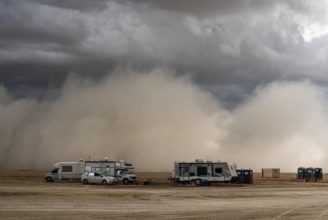
It may have been the most beautiful night of the whole week – perfectly still, comfortably warm and lit by a near-full moon. During the daytime, an exodus had begun from Black Rock City, and the population had shrunk to maybe half the 52,000 participants who were here at the peak of the event. The refugees kicked up plenty of dust on their way out, but it hung low in the air, like tule fog in the Central Valley on a chilly winter night.
One more big burn, and then the work to restore the Black Rock Desert to its natural state would begin. This would be the first time in five years that a David Best temple would burn on the playa. After he built the temples of Mind, Tears, Joy, Honor and Stars from 2000 to 2004, Best retuned in 2007 to build the Temple of Forgiveness. And then he left it to others to carry on the tradition. “I hoped that other people (on his crew) would step up, but it didn’t happen,” Best said yesterday.
During last year’s event, Best was getting his bike worked on at the DPW’s bicycle camp when a young, heavily tattooed woman approached him to say thank you for all he had brought to Burning Man. It was a turning point. “It touched me deeply,” Best said. “When someone thanks me, you have no idea what that means to me.” And that simple act of gratitude planted a seed.
Best’s crew had been asking him why they couldn’t do it again, get back out there and build another Temple. And then, when his wife, Maggie, said that if he wanted to build another Temple, she would help him, the decision was made. “She’s over there now,” Best said, waving his arm in the direction of the camp’s kitchen, “feeding 120 people a day.”
And so Best and his crew worked for months off the playa and for many weeks on it to erect the Temple of Juno. It was a beautifully detailed, Asian-influenced structure, instantly recognizable as a Best creation. And on this perfect night, it would go up in flames, and the drifting smoke would lift the sorrows of many thousands of people who use the burning of the Temple as a release from their pain.
During the week, the Temple is heavily decorated with inscriptions and pictures and trinkets – mementoes of those who have passed away, placed there by people seeking to honor their memory. But the Temple is not simply a collective funeral pyre; Best sees it as part of a healing process, a first step toward moving beyond the pain from loss and grief.
“The dream I had was that the community would heal itself,” Best said. Read more »